
Driving High Performance Without Burnout
Most CEOs eventually face a difficult leadership tension:
How do you demand high performance without burning people out or eroding trust?
Many organizations resolve this tension poorly. They drift toward one of two extremes—either driving results so hard that people disengage, or emphasizing culture so heavily that execution weakens.
The best organizations resolve this tension differently.
They create what I call a redemptive management environment—an approach to leadership that strengthens people while delivering exceptional business performance.
The Leadership Continuum
Over time, I have come to see leadership environments operate along a continuum.
At one end lies exploitative management environments, where people are treated primarily as inputs to produce results.
At the other lies redemptive leadership, where individuals grow stronger through their work while still being accountable for meaningful performance.
Below is a simple way to visualize this continuum. Most leaders know immediatLeader
ely where they are.
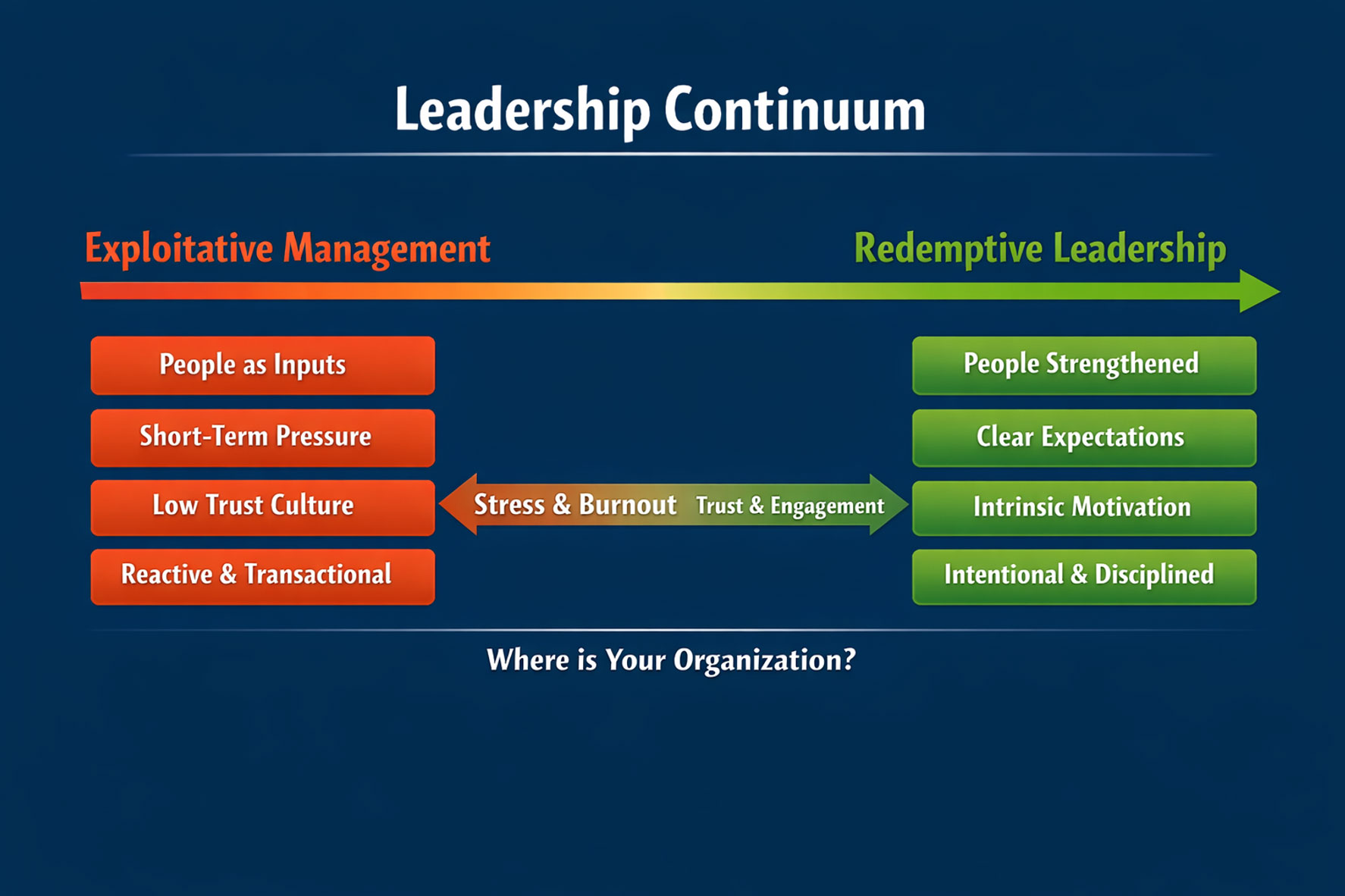
Every organization sits somewhere on this spectrum—whether leadership recognizes it or not.
And where a company operates on this continuum profoundly affects employee engagement, innovation, and ultimately business results.
A Moment That Confirmed My Perspective
My understanding of this became clearer during a leadership project with one client organization.
An employee said:
“When I board the train to go to work, a smile breaks out on my face.”
At first, I assumed it was an isolated comment.
It wasn’t.
Many employees expressed similar feelings.
They arrived at work motivated, focused, and ready to contribute. They understood the importance of their contributions. They trusted their managers and felt supported in achieving demanding goals.
These individuals did not need elaborate incentive systems to perform well.
They were already intrinsically motivated because the work environment itself strengthened their commitment and capability.
That experience made something clear:
The best organizations do not merely manage people—they elevate them.
What Creates a Redemptive Organization?
Redemptive leadership is not soft management.
It is disciplined leadership supported by clear organizational systems.
In organizations where redemptive leadership thrives, several elements consistently appear.
Mission and values clarity
Leaders articulate where the company is going and define values that genuinely guide behavior and decisions.
Strategic alignment
Strategic priorities are clearly communicated and cascade throughout the organization.
Structure that supports execution
Roles are intentionally designed so accountability and authority are clear.
Right people in the right roles
Individuals are selected and developed so they can fully use their capabilities.
Effective operating systems
Operational systems allow people to perform their work efficiently and effectively.
Managers who understand accountability
Leaders balance authority with responsibility while developing the capability of their teams.
When these elements align, employees experience something rare in many organizations:
clarity, fairness, challenge, and meaning in their work.
The Performance Advantage
Some leaders assume that strong people-centered environments come at the expense of performance.
In my experience, the opposite is true.
I have personally seen redemptive management environments deliver exceptional business results in organizations ranging from:
- A global enterprise approaching $500 million in revenue
• A $40 million U.S. manufacturing company
• A startup in Turkey just surpassing $2 million
Different industries. Different cultures. Different stages of growth.
The common denominator was management systems that brought out the best in people while maintaining clear accountability for results.
Organizations operating closer to the redemptive end of the continuum consistently outperform those operating closer to the exploitative end.
A Question Every CEO Should Ask
Every organization sits somewhere on the leadership continuum.
Some environments quietly drain energy from people. Others unlock the very best of what individuals are capable of becoming.
The difference rarely comes down to culture slogans, incentive plans, or team-building exercises.
It comes down to the leadership systems that shape how work actually happens every day.
These conditions rarely occur by accident. They emerge when leaders intentionally design the organization’s operating system—the integrated way strategy, structure, management practices, and culture work together to drive performance.
The real question for any CEO is simple:
Where does your organization sit on the leadership continuum?
And perhaps more importantly:
Is it moving toward the redemptive side of leadership—or drifting away from it?
Comments are closed